

When John Verdon was growing up in Lansing, the son of a commercial fisherman on the Mississippi River, he recalls a time when the Black Hawk Bridge was closed to traffic. An ice dam loosened by a passing ship damaged the piers on the Wisconsin side in 1945, making the bridge impassable until it reopened in 1957. The bridge still looms large in the 85-year-old’s memory.
“It had a profile that people got used to seeing, and it was on all the pictures and photographs. It was the Black Hawk Bridge at Lansing,” said Verdon, who retired back to the community. “You get attached to a major feature like that.”
This summer bears some similarities to those years of Verdon's childhood. The original bridge that opened in 1931 is now gone. It was demolished on Dec. 19, 2025, as the Iowa Department of Transportation (DOT) worked to construct its successor, which is expected to open in spring 2027.
The closure has not only left the remote bluff towns of northeast Iowa and southwest Wisconsin without their iconic landmark. It has also brought a summer of construction, declining tourist traffic and 50-mile detours to a region that depended on the bridge for its daily life.
Lansing — with a population of 900 — has proved resilient, winning accommodations and steering the replacement project with a passion for its storied predecessor.


Coping with the closure
For Justin Shepard, there’s only one word to describe a summer in Lansing without the bridge: different.
“I wouldn't say [businesses are doing] well,” he said, standing outside Shep’s, his riverside bar and grill. “But you know, we're trying to get through. That's about what you can do. Keep your head above water the best you can.”
Shepard said the impacts have varied between businesses. He’s observed a sharp decline in late-night customers, as tourists head home earlier in anticipation of a longer drive.
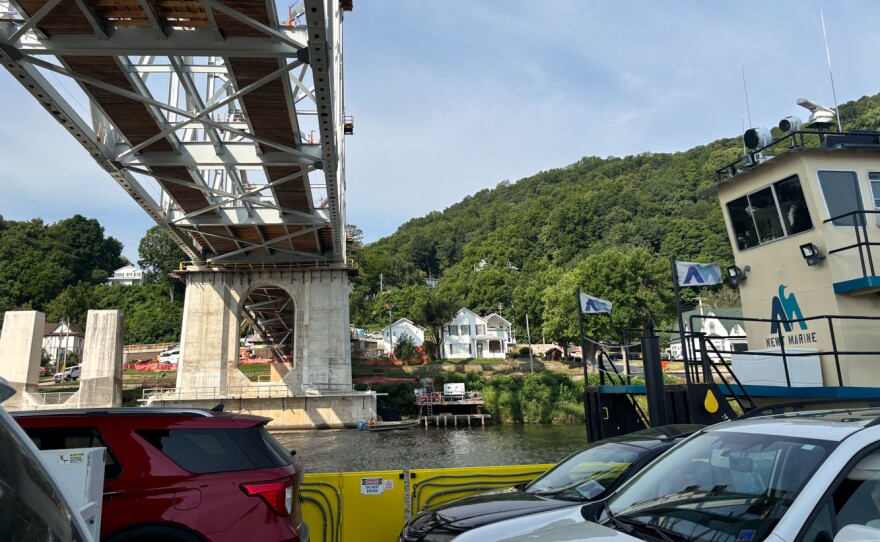
A ferry service provided by the Iowa DOT has allowed cross-river travel to continue, but it makes its last trip at 9:15 p.m.
Rick Welsh, who owns a hardware store on Main Street, said the ferry has been a lifeline for businesses. He noted that half his customers come from the Wisconsin side of the river.
“It’s not ideal, it’s not perfect, but we’d be lost without that ferry,” Welsh said.
The service added an estimated $20 million to a project approaching $200 million in cost, according to the Iowa DOT. It offers continuous service across the river, seven days a week, and serves roughly 550 cars a day. The bridge often served over 2,000.
The Iowa DOT, which is collaborating on the replacement with the Wisconsin DOT, planned to finish the new bridge before destroying its predecessor. But construction exposed weaknesses in the old bridge, leading to its closure and demolition.
News of the closure was met with “upheaval,” said Lansing Mayor Mike Verdon.

“There are about 8,000 people who live within a 25-mile radius of that bridge who use it regularly — several times a week. So, there are a lot of lives that are impacted by this closure,” he said.
A stakeholder group of leaders from both sides of the river assembled to find a temporary solution. When Gov. Kim Reynolds visited Lansing shortly before the bridge’s demolition, Mayor Verdon said she was receptive to their requests. Shortly after, the Iowa DOT began work to implement the ferry service.
In addition to the financial burden, the service required the relocation of aquatic species, including the endangered Higgins Eye Pearly Mussel, from embarkation points.
But the mayor said no businesses have permanently closed because of the bridge closure, and the ferry can reduce the trip to a community across the river by 40 minutes or more.
A project driven by passion
The advocacy that made that ferry possible is a hallmark of the project overall. When the Iowa DOT began planning in the late 2010s, it proposed an arch bridge for the site, which is considered more cost-effective and efficient.
“But you see them built everywhere because of that, and they’re not historic landmarks. They’re just another bridge,” said Project Manager Clayton Burke. “Working with stakeholder groups, they didn't accept that. They didn't see that as an appropriate structure for this area.”
The Iowa DOT turned to the National Historic Preservation Act and secured additional funds for a steel truss design to mimic the original 1931 bridge. Burke estimated it increased project costs around 15%.


The original crossing was built by the Iowa-Wisconsin Bridge Company as a for-profit endeavor, charging a toll. It had a cantilever truss design and was recognized as eligible for the National Register of Historic Places in 1995.
Iowa DOT Cultural Resources Team Lead Brennan Dolan, who joined the project at the start, recognized it had some “major safety concerns.”
“We don’t design bridges like that anymore,” he said. “But, for anyone who drove over the Lansing bridge, it was a unique experience in and of itself.”
The steep pitch would launch travelers as they crossed onto the center span, creating a moment of suspension before the stomach dropped. The open-grate decking clattered with crossing cars, earning it a nickname: the singing bridge.
Dolan said the community’s passion for the structure was clear from the outset.
“I work on historic bridge projects all across the state,” he said. "The community engagement [in Lansing] was absolutely remarkable. We get that in other places, too. But time and again, Lansing showed up for us.”
During packed public meetings, the Iowa DOT worked to honor the community’s input in the final design.
“I think when you grow up around a bridge that's as iconic as Lansing was, you can't help but be impacted by it,” Dolan said.

An anticipated opening
The Iowa DOT estimates the bridge will open next spring, but Burke said the agency is “working really hard to get it open as early as possible.”
The center span of the new truss was lifted into place on June 12, and the decking was completed on Aug. 24. Crews are now turning to safety barriers and connecting roadways.
Even after the new bridge is open, more construction could bring business and traffic challenges to Lansing. The Iowa DOT is planning to redesign and resurface the city’s Main Street and sidewalks in 2028.
Still, community members are anticipating the return of their iconic crossing. John Verdon said he checks the progress almost daily.
“It looks great,” he said. “Every time I go under the bridge or drive past it, I get excited. I'm anxious to drive across it.”
