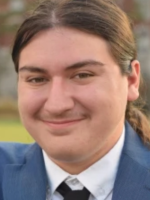
In November, a man who spent 32 years in prison for a crime he did not commit became a free man.
Danny Davis was exonerated with help from the Illinois Innocence Project based at the University of Illinois Springfield.
Davis was convicted for stabbing a woman to death in her Cairo home in 1992. Davis, who was 20 at the time, was taken into custody and questioned, along with his brother.
Davis said police coerced confessions through physical and psychological abuse. DNA evidence later proved their innocence.
His brother, Isaac, was previously released.
Now 52, Danny Davis spoke about his experience along with his legal team.
The following interview with NPR Illinois reporter Evan Holden has been edited for clarity and length. It features:
IIP Senior Staff Attorney Maria de Arteaga
IIP legal Director Lauren Kaeseberg
Danny Davis
Holden: What is your name and then your role in Danny Davis getting exonerated?
de Arteaga: My name is Maria De Arteaga and I'm a senior staff attorney at the Illinois Innocence Project and I was one of the attorneys working on Danny Davis's case.
Kaeseberg: And I'm Lauren Kaeseberg, Legal Director at the Illinois Innocence Project. We have worked on Danny's case for a decade now. We opened his case in 2015 and have now been able to see him be exonerated. But it took 10 years.
Davis: My name is Danny Davis and I'm the one who's been exonerated.
Holden: Can you kind of talk about your story from being in prison to now being exonerated and then where both of you came in?
Davis: We're in 2015 Anderson told me to write to the Innocence Project and I did that. Fortunately, they accepted my case. But fortunately, they did take my case and I sent them all the paperwork when they asked for it and then they started going to work for it like investigating my case and seeing the flaws in my case and that I was actually innocent of the crime. So, they did the DNA test in my case and now it shows that I'm actually innocent of the crime.
I was exonerated on November the 12th where charges have been filed to dismiss it due to the fact that the DNA don't match. Me or my co-defendant or the other co-defendant. Our other co-defendant is my brother Isaac Davis. We, all three, were innocent of this crime.
de Arteaga: Yeah, all three were charged with the murder of a woman in Cairo, Illinois and what Danny is talking about with respect to the DNA is that DNA that was taken from fingernails of the victim excluded Danny, Isaac and Debo Johnson.
Kaeseberg: This is really an outrageous case where you had a horrific murder of a woman in her own home. The police had an opportunity to get it right at the time and solve that case and put the right person behind bars, but they didn't do that and instead they arrested Danny, his brother and an acquaintance of theirs. At the time, the police coerced false confessions from Danny and his brother. They used their vulnerabilities against them.
They pitted each other. It made Danny feel like he had to save Isaac and Isaac make like he had to save Danny. Got false confessions from both of them.
Ultimately, Danny was charged with capital murder facing the death penalty. And the prosecutor took him in a room in the courthouse before a trial and said If you don't plead guilty to this case, you're going to get convicted and you'll be dead within 30 days, which is not true.
I mean, he doesn't know what's going to happen to the trial, first of all, and used this horrendous threat of his own death within 30 days against him, coerced him to plead guilty to a crime he did not commit. Him and his brother plead guilty in front of a judge, the evidence against them was barely existent, but for this false confession, the judge accepted their guilty plea and sentenced Danny to life in prison without parole.
The third person who was charged actually went to trial and fought the case. There was no he did not confess. And so, he thought had a chance at trial, which was a bench trial, which means a trial without a jury in front of a judge, in front of the very same judge who had just sentenced Danny to life in prison, and he acquitted that third person, who was found not guilty because the confessions were not reliable evidence to use to convict him. And no one ever did anything about that.
So, for decades, Danny and his brother have maintained and told every person who would listen, "I'm innocent. I did not commit this crime." When he entered his guilty plea. He said to the judge, "I'm only doing this to save my life." The judge didn't listen, the prosecutor didn't listen, no one listened and it took Danny and his persistence.
He's very modest, but you know, fighting and surviving all those years in prison and finding the courage to keep going every day and finally we were able to hear those pleas and accept his case and we're so grateful.
It took us a long time. It took us a decade to get there, arguing different things, doing all this testing, but ultimately being exonerated.
Holden: Can you talk a little bit more about your persistence? When it comes to your innocence?
Davis: Well, I just uh just never gave up.
I just kept on fighting. A lot of guys and I just be like, "When your natural life is over with. This is your home. Give up." I was like, "No, this is not my home. I didn't do it. I'm going to keep fighting." My mother passed and I told her before she passed, I said I would keep fighting to my last breath. And that's what I've done.
And that gave me hope to keep fighting. When people say you can't do it, I said I can. I knew I was being a rare road into the prison system. So, I never gave up and I thank the innocent project, the exoneration project for believing in me, taking my case, and fighting my case, and winning my case.
If it wasn't for them, I wouldn't be sitting here today. Period.
Holden: Can you talk about the process of finally getting exonerated?
de Arteaga: So, after Danny wrote into the Innocence Project New York and the Illinois Innocence Project and the two projects jointly took his case. The first thing that was done was preparing a motion for DNA testing.
There were definitely some issues with that.
I know I think you could probably talk more about how they couldn't find evidence and the clerk's office claimed that the evidence was missing and eventually after court orders to continue that search to find the evidence, they were able to find that fingernail evidence had been preserved.
And so that evidence was tested and while that was happening and after the team continued needed to actively investigate the case and also get a false confession expert involved with the case and through investigation and a lot of document requests the team discovered that there was a lot of important information that was never turned over to Danny or his defense team pre-trial including some really important 911 call records and a lot of information that would have been incredibly helpful in identifying really the true perpetrator.
And so, after gathering all that information and undertaking that investigation combined with these results of the DNA testing from those fingernails that eliminated Danny and his co-defendants and this was a crime scene where it was very clear that there was a main struggle so fingernails are really important pieces of DNA evidence in those types of cases.
The next step then was filing a motion in court to vacate Danny's conviction which resulted in getting an evidentiary hearing where we got an opportunity to present all this evidence to a judge and that judge heard that evidence and agreed that Danny's conviction should be vacated.
On November 8th, he walked out of prison a free man and it just so happened a year to the day. Finally, the state dismissed the case and decided not to move forward with retrying him or trying him and we were so happy for Danny.
Holden: Can you talk more on how it feels to be exonerated?
Davis: Oh, shoot, I was jumping over the roof. I was jumping over the roof.
It's just like a weight off my shoulder, weight off my family shoulder. Because when you go into the, you just not doing the time yourself, your family doing it along with So, when I had got exonerated, they got exonerated. Now I just enjoy them. You know, I don't, I don't take them for granted. Nothing that I do for granted and I definitely don't take these guys, my legal team, for granted.
I thank them. I am grateful to them. Seriously. I'm grateful to them. But yeah, I like I say man, I just enjoy life. laughter, fun, just go about my day. Because I think about those days like when I was in that cell, like man, you can’t do this. You couldn't go outside when you wanted to.
Now I could go outside, but I don't take it for granted, I just enjoy it because I have it now. So, I definitely enjoy it.
Holden: Can you speak a little bit more to the role the Innocence Project had?
Kaeseberg: I think one of the hardest parts about doing this work is that we know that there are thousands of people who are innocent who won't be exonerated. We get hundreds of letters every year from people asking us to look at their case and pleading their innocence. And we take as many cases as we can.
We work really hard to try to exonerate and obtain freedom for as many innocent people as we can. But we know that there are thousands of people in jails and prisons in Illinois who didn't do what they're there for. When we have the ability to celebrate a big victory like this and be able to bring somebody freedom and bring them exoneration. We really do try to celebrate that and soak it in.
On the occasions when someone like Danny gets out of prison then is exonerated around the time of the holidays, it has such a special feeling. The holidays are so difficult for incarcerated people and their families.
He texts us almost every morning and says good morning and it's such a beautiful thing to receive and we joke sometimes and say like one of the best things is being able to put our clients' phone numbers in our phones when they are free and they get their own cell phone for the first time ever.
Because even like we work on these cases for years and in Danny's case for a decade, every time we were able to communicate with him had to be pre-scheduled, arranged, or setting up legal calls, you're setting up visits, you're driving six hours down to Menard to do a visit, you're driving to these various correctional facilities around the state, and there's never the ability to just have them reach out to us when they need us or spontaneously talk to them. So, there's freedom just in that of the things that you forget, you do take for granted every day.
You can pick up the phone and call the person that you want to talk to, you can reach out to them, and you can talk privately.
Holden: What are your future goals either legally or just in general?
Davis: My future goal is just spend time with my family, travel, and let my lawyers just deal with all the legal stuff. Just let them deal with it. And just just go live my life. Because they took majority of it. Just go live my life and have fun with my family. That's it. And nothing else I can do. Can't think about the past, it's gone. So, you got to go forth.
Can't be better. You just got to accept what you got now. and be happy and thankful. But name number one thing is I never forgot God. I always kept God first and everything that I did. I didn't mention it first but he was number one. Now I just serve God and enjoy my family, travel, whatever God gives me the ability to do.
Holden: Are there any future goals legally or are you just waiting right now?
Kaeseberg: I mean I think at some point, you know, Danny deserves that certificate of innocence. I mean he's been exonerated. Um, a certificate of innocence in the state of Illinois entitles you to some compensation.
Currently, the amount of compensation that a person is entitled to is capped at a certain amount. It's around $280,000 no matter how much time you did in prison. That falls woefully short of anything that's at all respectable but also falls short of the federal and national standard of what people should be getting. Um the Illinois Innocence Project has been championing legislation for a couple years now.
We're really hopeful that in the spring session, we will be able to pass legislation that would bring the amount of compensation that a person is entitled to $50,000 a year for each year they were incarcerated. For someone in Danny's position who was in prison for over 30 years, what he would currently get under that framework is around $6,000 a year for every year that he was in prison. Compensation is really restitution. It's the state making something as right as they can.
It's not about anything but that. That the state got this horribly wrong. They took time from him. They took him away from his family, they took him away from us and all the things we could, you know, society could have benefited from and he deserves to have some amount of restoration just like any other innocent person. So, the goal of it, of a certificate of innocence is really it includes that, but I think it's also just the restoration of someone's name.
The same court that you were convicted in when you get that piece of paper that declares you were innocent is really meaningful to people. There are cases actually ongoing right now in the state of Illinois where people have been through their entire court process. They've even had civil cases that have been resolved and they're still fighting to get that certificate of innocence.
It's not about the money, it's about getting your name back.