

For its fifth year, the Refocus Film Festival expanded its footprint and welcomed award-winning filmmakers, literary luminaries and popular podcast hosts in a weekend-long celebration of “the art of adaptation.”
The four-day festival is hosted annually by FilmScene, Iowa City’s nonprofit cinema organization. This year’s edition took place Oct. 22-25 in downtown Iowa City, with film screenings and special events spread across FilmScene’s Chauncey and Ped Mall locations, as well as the Englert Theatre and an additional temporary screening room up the block.
“It's a year full of new developments. For us, that means breaking out of our five screens that we've had for many years. We are adding a sixth venue this year over at the Masonic Lodge, just around the corner,” said Andrew Sherburne, executive director of FilmScene. “Five also means growth in audiences. Our first festival year, we had 2,000 festgoers; and this year, our fifth year, we expect over 5,000 festivalgoers, making this by far the biggest weekend of the year for FilmScene.”
The final tally of total tickets sold was 5,041 tickets, up 32% from the 2025 edition of the festival. In addition, 50 of the festival’s 71 ticketed events were sellouts, according to Sherburne.
Honoring acclaimed director Andrew Haigh
One of those sold-out events was the opening night screening of A Long Winter, the new drama from British writer-director Andrew Haigh. As one of the festival’s two showcase guests this year, Haigh attended the opening night event at the Englert Theatre and participated in a Q&A following the film. Haigh, whose previous films include 45 Years and All of Us Strangers, discussed the process of adapting A Long Winter from the original short story by Irish writer Colm Tóibín.
“I love this idea that his story existed as one thing and still exists as one thing, and then my film can exist somewhere else in a different time, in a different place,” Haigh said. “But still there is this sort of beautiful connection between the two stories.”

While Tóibín’s original story is set in Spain, Haigh chose to move the narrative to the American West in the 1950s. There, the film centers on Mike, a sexually repressed young man who must contend with the sudden disappearance of his mother and the subsequent fallout with his father in the snowy wilderness.
“It's a very unusual heroic trait in an American film, that your heroic trait is sensitivity rather than strength. But that, to me, was what's fascinating,” Haigh said. “In so many narratives, the hero has to be incredibly strong and dominant, and I didn't want that. I wanted someone to come into his vulnerability.”
Haigh was also on hand to receive this year’s Cinema Savant Award, FilmScene’s highest honor that, according to the organization, is “bestowed upon filmmakers who have made an indelible impact on the world of cinema.” The award was presented to Haigh before a special screening of his Oscar-nominated 2015 drama 45 Years. Afterward, Haigh discussed his creative process in a conversation with screenwriter David Kajganich.
“The minute I start reading something, it's in my head as a visual thought, as a scene, as a person in a space, in a room, whatever they might be saying or feeling or how they're moving,” Haigh said. “So I see it very quickly from that level. It's always on a visual level.”
New awards contenders and revived classics
A Long Winter was just one of the many movies that screened at this year’s Refocus Film Festival. In total, the festival played host to 30 feature films, including 22 new releases and eight “restored or reloved classics,” as well as seven short films.
Among the new releases were several high-profile Oscar hopefuls making their Iowa — and, in some cases, Midwest — debuts. All of a Sudden was one such film. The multilingual drama from Japanese director Ryusuke Hamaguchi premiered earlier this year at the Cannes Film Festival, where lead actresses Virginie Efira and Tao Okamoto shared the award for Best Actress.
Efira plays Marie-Lou, a nursing home director whose life is forever changed when she meets a playwright named Mari, played by Okamoto. The heartwarming (and heartbreaking) story evidently struck a chord with Refocus attendees, who crowned the film with this year’s coveted Audience Award.

Other major new releases that screened at Refocus include fellow Cannes winners La Bola Negra and Minotaur. Directed by Javier Calvo and Javier Ambrossi, La Bola Negra is a generation-spanning epic that explores the connections between three gay men before, during and after the Spanish Civil War. Minotaur, meanwhile, is an austere drama from director Andrey Zvyagintsev. It centers on a marriage in turmoil under the shadow of the ongoing war between Russia and Ukraine.
A couple other top films from the festival were Look Back and Once Upon a Time in Harlem. Adapted from the popular manga of the same name, Look Back is a life-affirming and gently told coming-of-age drama from Japanese filmmaker Hirokazu Kore-eda.
Once Upon a Time in Harlem is an archival documentary posthumously directed by William Greaves and finished by his son David. Set in 1972, it presents a momentous meeting between some of the surviving members of the Harlem Renaissance, roughly four decades since the height of that landmark cultural movement.

The classics lineup at Refocus also offered several standout screenings. One of these was a special presentation of the 1926 horror film Faust. F.W. Murnau’s German Expressionist classic was given new life in the Masonic Lodge, where electronic music duo ten thousand lakes (xkl) performed an original live score to accompany the film.
Michael Mann’s 1986 crime thriller Manhunter was also given another chance at life. The film’s new 4K restoration, called Manhunter: The Final Cut, screened at Refocus, marking the culmination of a decades-long critical reappraisal for Mann’s previously misunderstood cult classic.
Blank Check takes the lid off the Garbage Pail Kids
Speaking of cult classics, few films fit that bill better than The Garbage Pail Kids Movie, which closed out this year’s festival as part of a special screening presented by the Blank Check podcast.
Widely regarded as one of the worst movies ever made, The Garbage Pail Kids Movie stood in stark contrast to the lineup of critically acclaimed films that populated the festival. That fact was not lost on award-winning writer and regular Blank Check guest Emily Yoshida, who introduced the film to a boisterous crowd inside the Englert Theatre on Sunday night.
“First of all, I'm sorry in advance for what you're about to watch,” Yoshida said. “I hope you all took advantage of the free barf bags in the back of the house.”
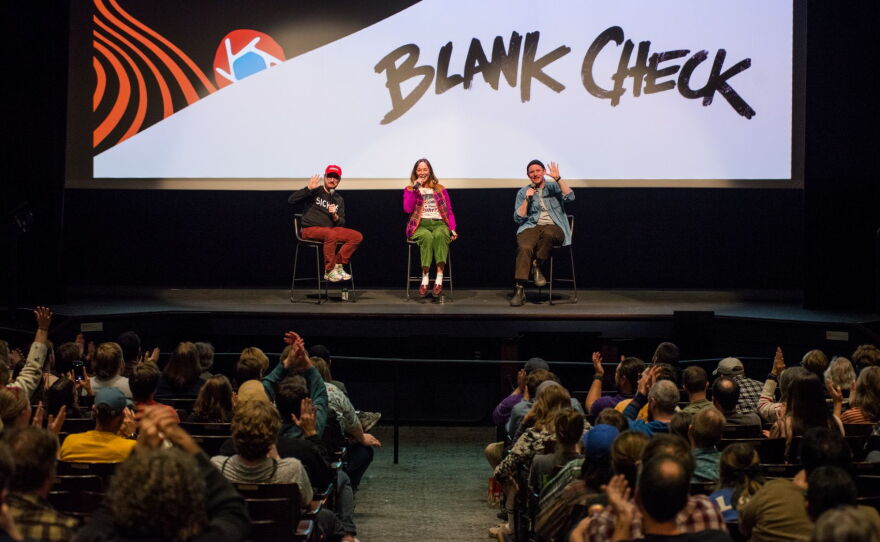
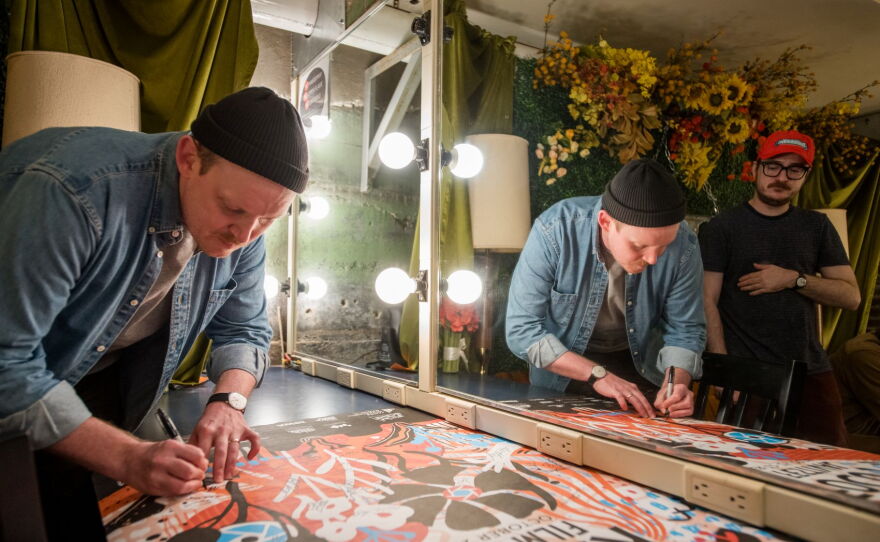
Originally released in 1987, The Garbage Pail Kids Movie takes its name from a briefly popular series of grotesque trading cards meant to parody Cabbage Patch Kids dolls. Although it was ostensibly marketed toward children, the film is anything but a family-friendly time at the movies. Rather, it’s a pitch-imperfect example of a “so-bad-it’s-good” movie, complete with over-the-top performances, laughably bad animatronics and an increasingly nonsensical plot.
Fortunately, the attendees at the Englert Theatre were all in. The closing night screening was filled with uncontrollable bursts of laughter and screams of giddy disbelief, which only surged with the arrival of Blank Check host Griffin Newman and producer Ben Hosley for a live podcast recording following the film. Yoshida joined Newman and Hosley on stage for the freewheeling conversation, which covered the film’s bizarre production behind the camera and its irredeemable qualities in front of it.
A reading with Jane Schoenbrun and continued conversations
Blank Check wasn’t the only podcast to record a conversation at Refocus this year. Filmspotting, the long-running weekly show hosted by University of Iowa professor Adam Kempenaar and Chicago-based writer Josh Larsen, returned to the festival for an episode inspired by the opening night film A Long Winter. The topic, fittingly, was “Top 5 Winter Movies.”

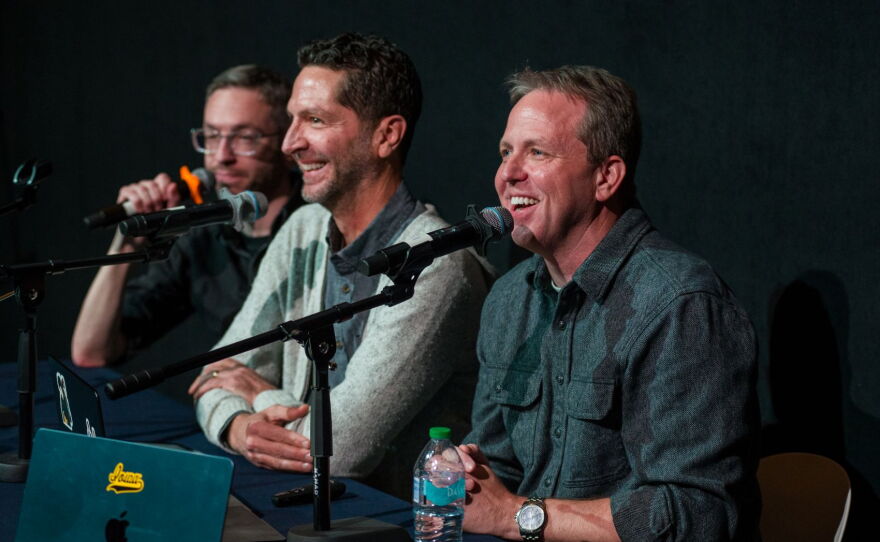
Kempenaar and Larsen were joined by film critic Matt Singer for a countdown of their respective lists. Singer’s top picks were Batman Returns, Fargo, The Shining, Home Alone and the 2026 reboot of Resident Evil. Kempenaar and Larsen shared a joint list, ranking Winter Light, John Carpenter’s The Thing, The Gold Rush, The Sweet Hereafter and The Weather Man.
The weekend featured many other conversations, as well as art installations, live music and readings in collaboration with the Iowa City Book Festival. One of the most hotly anticipated of these events was a dialogue with festival showcase guest Jane Schoenbrun, the writer-director behind the films I Saw the TV Glow and Teenage Sex and Death at Camp Miasma.

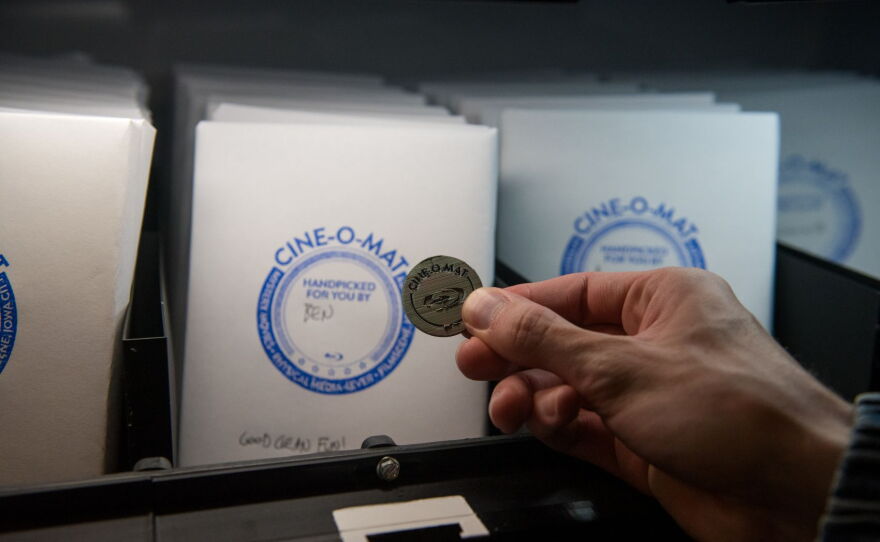
Schoenbrun took to the stage in the Masonic Lodge to read excerpts from their debut novel Public Access Afterworld and to participate in a Q&A with Iowa City-based author Rachel Yoder. Schoenbrun discussed the process of writing the book and the early influence of television in their creative development.
“When I was a kid, I would watch TV,” Schoenbrun said. “And yeah, my parents would tell stories about how I would sit in the back of the car in my car seat before I could even talk mostly, and… I would make up TV shows.”

By the end of the four-day festival, the whirlwind of events in and around downtown Iowa City left a palpable buzz in the air. For FilmScene Programming Director Ben Delgado, that feeling of excitement also came with a chance for reflection, which he shared with festival attendees during his opening night remarks.
“This weekend, we all join together with our community and those who came from afar to celebrate the work of artists who are giving us the tools to find ourselves, to find our own meaning in a world that's getting harder and harder to identify with,” Delgado said. “We seek to continue the conversation right here with our friends and neighbors about what it means to be alive and how we can all feel a little bit more like we belong.”
—
FilmScene and the Refocus Film Festival are sponsors of Iowa Public Radio.
