

With a shovel in hand and a sea shanty playing nearby, University of Iowa senior John Morris sifted through soggy soil, hoping to uncover another piece of Iowa's past.
Morris, who's from Cedar Rapids, said every artifact, no matter how small, has something to teach.
"I've always loved stories, and I believe every object you come across, every artifact you find, has a story," Morris said. "I love discovering what that story is and sharing it so other people can learn about our history."
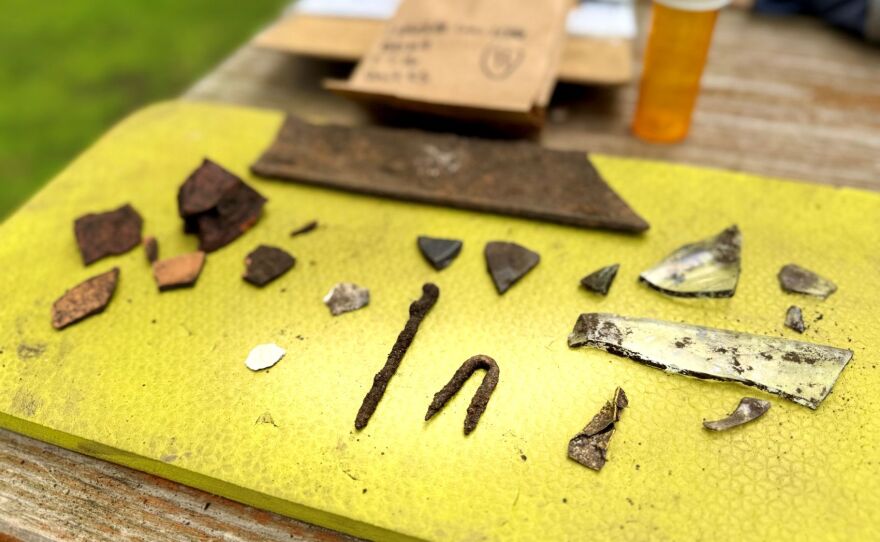
College students from across Iowa have spent the past five summers excavating the grounds surrounding the Abbie Gardner Cabin in Arnolds Park. Along the way, they've uncovered artifacts like coins, buttons, nails and pottery fragments.
The cabin marks one of the five sites of the 1857 Spirit Lake Conflict. More than 30 settlers were killed during a massacre involving members of the Wahpekute Santee Sioux led by Inkpaduta, following years of mounting tensions, starvation and the loss of tribal lands.
They held 13-year-old Abbie Gardner captive and released her about three months later. Gardner returned as an adult to buy her family's home and preserve it as a museum, helping establish one of Iowa's earliest tourist attractions.
"While some sad events did happen here, there's more that came after," Morris said. "I'm reading Abbie's book right now. She wrote, 'Through the writing of this, I have found and made peace with the people who held me captive.'"
This year's Iowa Lakeside Laboratory field school, led by State Archaeologist John Doershuk, is expected to be the final excavation at the cabin. Researchers have completed more than 50 1-meter-by-1-meter excavation units and believe the site has revealed much of what it can for now. Doershuk said future field schools will shift to other locations in the Iowa Great Lakes region.
"I think we've done enough here that preservation in place is a better strategy, and we'll let future generations decide if there's something else to learn here, maybe with new techniques that we don't have today," he said.
For Doershuk, the excavation has never been just about what students uncover. It's also about showing them what archaeology is really like.
"It's experiential learning at its best," Doershuk said. "On campuses and in classrooms, you can watch videos or watch other people doing this kind of work. But doing it yourself really teaches you what it's all about."


That firsthand work confirmed Emmalee Williams' career plans. The University of Iowa student from Independence said spending four weeks excavating the site showed her how physically demanding archaeology can be.
"There's a difference between learning about it and actually doing it," Williams said. "I knew it was going to be hard work, but actually doing it — oh, my goodness! Even finding a tiny little scrap of metal is rewarding."
The field school also broadened her understanding of the site's complicated history.
"It's harrowing, knowing something like that happened here, and she was just a little girl being torn away from her family," Williams said. "It's a two-sided story that really expands your understanding of the area and what the land means to different groups of people."


Her roommate, Josie Rebholz of Stevens Point, Wisconsin, took part in the program, wondering whether archaeology was the right career path. By the end of the four-week field school, she realized her interests lie elsewhere. She plans to pursue cultural anthropology instead, but said the experience gave her a new appreciation for archaeology.
"I've met a lot of great people. I think I'll stay in touch with them for the rest of my life," Rebholz said. "I've really learned a lot about myself, too, and that's pretty valuable, considering I'm still in college and just beginning my life."
Williams agreed. After weeks of digging, screening soil and sharing discoveries, the roommates expect to remain close friends long after the field school ends.

While students leave with new skills and lasting friendships, Doershuk hopes Iowa also invests in preserving the cabin for future generations. Inside the nearly 170-year-old building, he pointed to the damp, musty smell as a reminder that it needs climate control and continued care.
"I think it would be wonderful if the state decided to put a little bit more money into these state properties they manage, like the Abbie Gardner Cabin," Doershuk said. "I'm hoping one of these students grows up to be in the House or Senate, or someone who can influence policy and promote historic preservation that adds value and quality to our lives."
