

If you haven’t made a day trip recently to the elegant, extraordinary Muscatine Art Center, you must put it on your holiday wish list this month.
The 1908 mansion, which sits in a residential neighborhood (45 minutes from the QC) at 1314 Mulberry Ave., Muscatine, combines two of my favorite things – glorious historic architecture and a varied, spectacular collection of first-class art.

Celebrating its 60th anniversary this year (with three special exhibitions), the Laura Musser Museum/Muscatine Art Center is many things to the community of Muscatine — a historic house museum that honors a key family in the city’s history; a drop-dead gorgeous art gallery and museum that pays tribute to that indelible history.
Incredibly, since its 1965 founding, the Muscatine Art Center has been free to the public, and a beloved gathering place for celebrating the area's history, art and culture. As a department of the city of Muscatine, the Art Center's mission is to collect, preserve, interpret and exhibit objects of historical and aesthetic importance for the benefit of present and future generations.
The Muscatine Art Center was established as a museum in 1965 when Laura Musser's heirs, Mary Catherine McWhirter and Mary Musser Gilmore, donated the Musser Mansion to the city (which has a population of about 23,000 – smaller than Moline, Rock Island and Bettendorf).
Showcasing the 1908 Musser Mansion and adjoining contemporary Stanley Gallery (built in 1976), the Muscatine Art Center offers decorative arts associated with the original home, as well as new and exciting exhibitions in constant rotation.

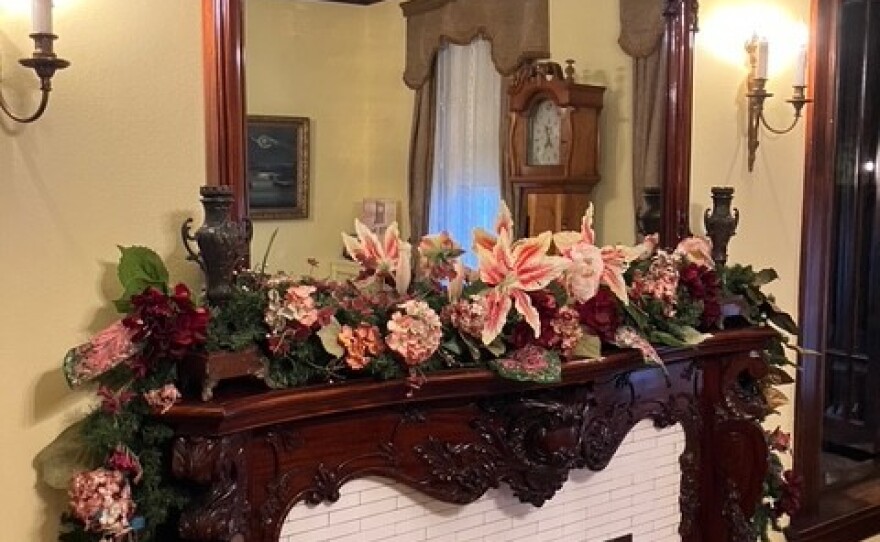
The beautiful historic home contains 12 rooms flanking a generous central hall on the first and second floors. Many original materials and architectural details including staircase, mantelpieces, stained glass windows, woodwork, light fixtures and hardware are distinctive examples of the period and architectural style. Period rooms are installed on the main floor.
The second floor originally consisted of a master bedroom suite with a wardrobe room, two guest bedrooms, three servants rooms, a sleeping porch in back, and a sun porch over the porte-cochere, plus bathrooms. Today, the second floor (note the large stained-glass panels at the top of the stairs) features the “Learn to Look” gallery for children, displays of the Early American Pattern Glass collection, a room for featured history collections, and several spaces for changing exhibitions.
The collection includes several works by Marc Chagall, paintings by Edgar Degas, Pierre-Auguste Renoir, Camille Pissarro, and Henri Matisse, and works on paper by Vincent van Gogh, Pablo Picasso, and Toulouse-Lautrec. The works on paper are occasionally exhibited as deemed appropriate to ensure their long-term conservation.
The van Gogh drawing is the only artwork from the legendary 19th-century Dutch artist in Iowa.
The Muscatine Art Center is one of only 1,070 museums nationwide accredited by the American Association of Museums (AAM). This honor signifies that the museum has undergone a rigorous and lengthy process involving intensive self-examination, peer review and a thorough examination by the Accreditation Commission. Accreditation by AAM means the Muscatine Art Center is recognized for demonstrating excellence and operating in accordance with the best practices and highest standards in the field.
Who was Laura Musser?
Born in 1877, Laura Musser was described in her wedding announcement to Edwin McColm as having “grown up unspoiled and unselfish.” In her youth, Laura studied music at Grant Seminary in Chicago and in Paris, France, and was noted for her beautiful mezzo-soprano voice.

Her 1920 Steinway grand piano in the mansion’s stunning music room is available for the public to play (as a trained pianist, I eagerly luxuriated in its sound at our recent visit). The room, with a 65-seat capacity, occasionally hosts concerts and the next will be with the annual Eagles and Ivories (a partnership with Muscatine County Arts Council) on Jan. 17 and 18, featuring Jeff Barnhart and Josh Duffee.
In 1903, Edwin McColm married Laura Musser. Edwin had apprenticed with the Marshall Field’s store in Chicago and worked for the family business, McColm Dry Goods Store. Edwin’s father had opened J. McColm & Sons in Muscatine in 1870. Eventually, Edwin became president and owner of McColm and Company, Muscatine's leading dry goods store.

Laura and Edwin had one child, a daughter named Alice, who died shortly after her birth in 1907. As a married woman, Laura became active in her husband’s business, keeping the account books for the McColm store for many years and often traveling with her husband on his buying trips to Chicago.
In 1938, five years after Edwin’s death, Laura married William T. Atkins and became stepmother to Mary Catherine Atkins (McWhirter). Following her marriage to William, Laura mainly resided in Kansas City. She retained ownership of the Musser mansion in Muscatine and made frequent trips to Muscatine, often en route to Minnesota or Chicago.
The Mulberry Avenue house was built for Laura and her husband Edwin by Laura's father Peter, a leading logging industrialist whose portrait is on the home’s second floor. It was designed by Muscatine architect Henry W. Zeidler.

After Laura’s second marriage in 1938 and lived in Kansas City, she retained ownership of the Muscatine house, and visited frequently, until her death in 1964.
The following year, her heirs donated the estate to the art museum along with a $100,000 endowment to maintain the house. A $1.5-million renovation of the facility was completed in 2017.
The Musser-McColm Historic District was listed on the National Register of Historic Places in 2017. Contributing properties include the 1908 residence, the carriage house from the 1920s, and the Japanese garden that was installed in 1929. The garden was restored over a three-year process, reopening in spring 2024.
What’s in the collection and exhibits?
I love the museum – tastefully decorated for the holidays – not only because of the quality of its permanent collection (Chagall! Picasso! Degas! O’Keeffe!), but the creativity of its rotating exhibits, on the second floor and contemporary Stanley Gallery.
The Mississippi River Collection spans the entire length of the river with paintings, prints, maps, artifacts, sculpture, and ephemera. Works by Henry Lewis, John Mix Stanley, Captain Seth Eastman, William Bunn, Frederick Oakes Sylvester, and Joachim Ferdinand Richardt are part of this collection. The Mississippi River Collection and the Regionalist Collection were substantially enhanced by a bequest from E. Bradford Burns.
Some items, such as Allan Houser’s Prayer of Peace sculpture located in the courtyard of the Stanley Gallery, have become icons. Other donated works, such as Georgia O’Keeffe’s White Lotus, have prompted out-of-state art museums to borrow the work for temporary exhibition.
In 1992, 27 works of art were presented as a gift to the Muscatine Art Center from the estate of Mary Musser Gilmore, niece of Laura Musser, given in memory of Mrs. Gilmore’s mother and father, Sarah Walker Musser and Richard Drew Musser.
Mrs. Gilmore once stated that her aunt Laura was responsible for her entrée into art appreciation. She traveled frequently in Europe and especially loved France, which inspired her to collect works by Edgar Degas, Pierre-Auguste Renoir, Marc Chagall, Vincent van Gogh, Camille Pissarro, Pablo Picasso, Raoul Dufy, George Rouault, Henri Matisse, and other internationally recognized artists.
A wide range of artifacts and works of art comprise the renowned Musser Collection. Furniture, photographs, dresses, paintings, glass, silver, diaries, music boxes, rugs and other decorative arts are among the items left by the Musser-McColm family.The Muscatine Art Center regularly hosts exhibits featuring Musser artifacts in the period rooms on the main floor of the family mansion. Laura Musser's heirs, Mary Catherine Atkins and Mary Musser Gilmore, gifted most of the house's contents, along with the house itself, in 1965. Since that time, many others have generously added to the Musser Collection.






In 2010, an additional 11 works of art from the Gilmore Collection were gifted to the Muscatine Art Center via the Sarah King Wilmer estate, daughter of Mary Musser Gilmore.
The Muscatine History Collection is as varied as the history of the town itself. Collection highlights include artifacts related to quack doctor Norman Baker and his radio station KTNT (Know the Naked Truth), author Ellis Parker Butler, speed boat champion Chap Hanley, Peter Mar toys, pioneer settlers, holiday traditions, the Civil War, local industries, and small businesses. Artifacts related to the pearl button industry, photographer Oscar Grossheim, the Muscatine High Bridge, broom making, cigar shops, passenger and freight railroad lines, and local churches help to tell the stories that make Muscatine a unique place.
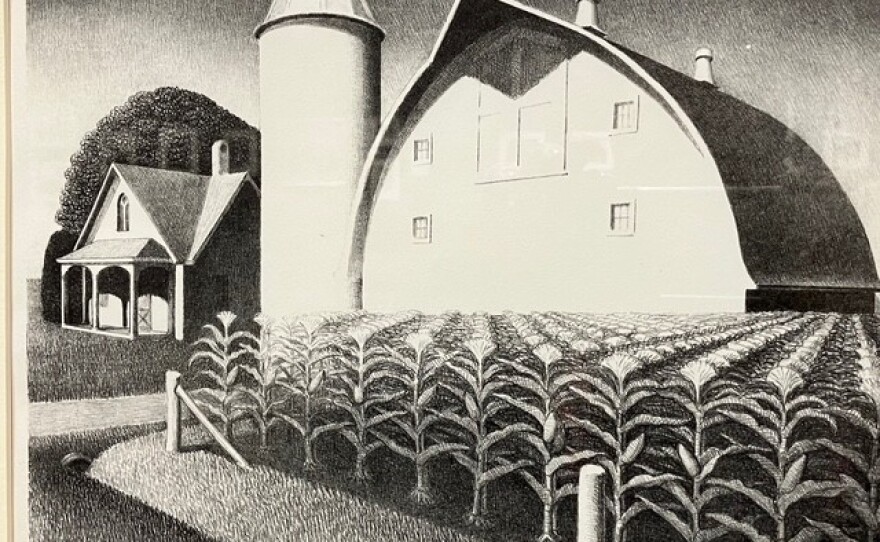
The Iowa Regionalist collection – excerpts now on display through Feb. 22, 2026 -- features works by Grant Wood and his Iowa contemporaries such as Marvin Cone, John Bloom, Alma Held, Arnold Pyle, Juanita Jamison, Harold Allison, and others, including Muscatine’s own, William Bunn.
Some of these artists are connected to Grant Wood through the Stone City Art Colony (outside Cedar Rapids, where John and Isabel Bloom met and married in 1938, their union lasting 63 years), while others overlapped at the University of Iowa’s School of Art. Some completed Works Progress Administration (WPA) murals under the supervision of Grant Wood, while others also exhibited in the Iowa Art Salon in the 1930s.
There are many black-and-white Grant Wood lithographs in the current exhibition, I wondered why some are not on permanent display. Be sure to check out the 1946 John Bloom painting of a young Isabel (1908-2001) and child.

Museum director Melanie Alexander said Wednesday that Grant Wood is not on permanent display in the mansion mainly because of lack of available space.
“That’s a big issue for us. Those go on and off view,” she said, noting works on paper also can’t be on permanent view, to keep them in proper condition. “We would love to be able to have paintings from the Regionalist collection on long-term view, but we struggle with having enough space.”
The “Midwest Icons” exhibit highlights Wood, and his contemporaries Thomas Hart Benton and John Steuart Curry. Wood -- best known for "American Gothic" (1930) -- grounded his art in the landscapes and people of Iowa, while Benton’s sweeping murals and dynamic depictions of labor and rural life reflected his Missouri roots, according to the museum. Curry, who grew up on a Kansas farm, brought dramatic intensity to his portrayals of heartland scenes such as "Tornado Over Kansas" (1929).
“Together, these artists celebrated Midwestern life and values during the early 20th century, creating images that resonated with a nation searching for identity during the Great Depression,” Muscatine Art Center says.
Anniversary tributes
On the second floor, QC residents can take pleasure in the evocative art of familiar names – photographer Randy Richmond and painter Tim Schiffer.
Richmond (a Muscatine native who has taught photography at St. Ambrose University, and exhibited at the Figge Art Museum and Muscatine, among many venues) and Schiffer (former Figge executive director from 2012-2019, currently living in Coralville) have works on display through Dec. 31.
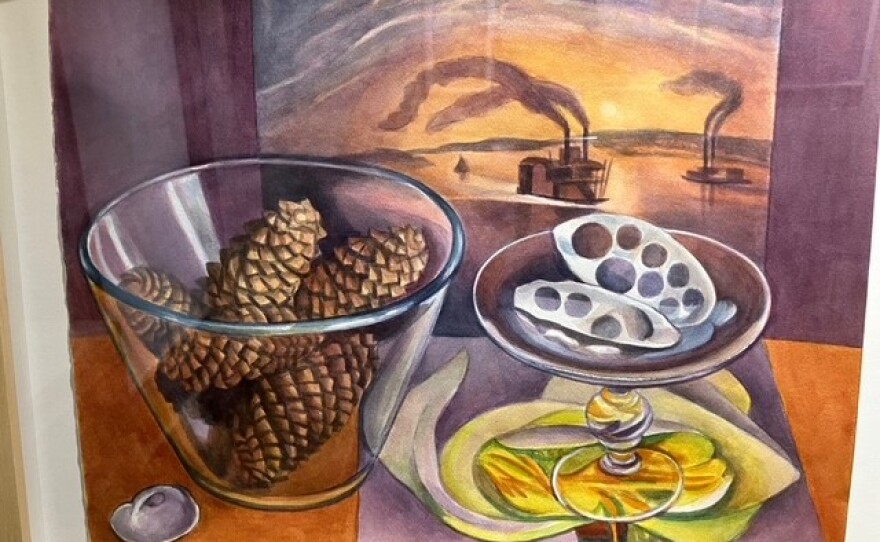
The room where Schiffer’s paintings hang is especially reflective of Muscatine, commissioned for the museum’s 60th anniversary. Several pieces pay homage to other permanent artworks – such as “White Lotus” and the Peter Musser portrait. It’s a sprawling, affectionate tribute to Muscatine.

“He did a nice job of referencing Muscatine and the Mississippi River,” Alexander said. “He featured tomatoes; there’s a lot of produce grown in the Muscatine area. There are references to the lumber industry, with pine cones. The original family who lived in the house was part of the lumber industry.”
Richmond’s photos were done for the art center’s 50th anniversary in 2015, tasked with looking behind the scenes of the museum with a photographer’s eye for detail, Alexander said.
Special Saturday event

Local and regional artists and crafters are also sharing their talents for a great cause this holiday season, and the Muscatine Art Center invites everyone to join in the fun this Saturday, Dec. 6.
The beloved Heartfelt & Handmade Ornament Competition has returned, and each ornament purchase supports Friends of the Muscatine Art Center and its mission to strengthen educational programs offered to the community. All competition entries are now on view in the Muscatine Art Center’s glass showcases near the main entrance.
The first chance to purchase these one-of-a-kind ornaments will take place during the Family Festival & Market on Saturday, Dec. 6th, from 10 a.m. to 1 p.m. Admission is free of charge. The Family Festival & Market transforms the historic Musser Mansion into a lively seasonal marketplace featuring craft and food vendors, holiday décor, and an exclusive opportunity to purchase collectibles from the estate of James (Jim) Burr.
Children can enjoy hands-on holiday crafts in the studio, pose for pictures with Santa, and warm up at a free-will donation hot chocolate bar. Visitors can shop ornaments and a festive assortment of handmade holiday goods from this year’s vendors: Rose & Daisy Designs, Celebrate My Home, Aunt Marg's Caramels & More, Connie Sherman, The Rendezvous, Trinckety, OxyGlass Art, Brianna Faith Rivers, Michele Nowak, Bonnie M. Buelt, and Jim Burr Collectibles.

This year’s entries were judged by Jame Hayes, Naomi DeWinter, and Cindi Kautz. The judges awarded first place to a three-dimensional stained-glass tree created by Ken Bierman. Second place was awarded to Marie Latta for her vintage jewelry tree ornament, and third place went to Kristy Cox for her crocheted depiction of Mary, Joseph, and Baby Jesus.
The People’s Choice Award is now open for voting. All visitors are encouraged to cast a ballot for their favorite ornament through Thursday, Dec. 4th.
“This event captures everything we love about the season—creativity, community, and a spirit of giving,” says center director Melanie Alexander. “The craftsmanship this year is extraordinary, and we’re thrilled to offer visitors a fun, festive way to support the Friends of the Muscatine Art Center and our educational programs.”
Each hand-crafted ornament is available for purchase on a first-come, first-served basis. After the Family Festival & Market, remaining ornaments will be made available to the general public.
For more information, visit the center website HERE.
This story was produced by WVIK, Quad Cities NPR. We rely on financial support from our listeners and readers to provide coverage of the issues that matter to the Quad Cities region and beyond. As someone who values the content created by WVIK's news department, please consider making a financial contribution to support our work.
