


Tim Youngquist always wanted to move back home.
“I think farming is a great lifestyle,” he said. “I had a great upbringing here in western Iowa.”
Youngquist left for Iowa State University at 18 years old and now works there as an agricultural specialist. But he comes back every fall to help with the harvest and wants to move back for good.
That makes him kind of unusual. Many people end up leaving rural Iowa forever. About two-thirds of Iowa counties lost population, according to the last U.S. Census.
At first, Youngquist and his wife, Mandy, struggled to find a decent place to live. That was, until they heard about a house in the small town of Kiron, near where Tim grew up.
“Well, first I thought he was crazy because we had to buy it on an online auction," Mandy said. "We looked at it once for about half an hour before we decided to buy it.”
Tim calls it Victorian-folk style. It's two stories tall, white, with a wrap-around porch and six bedrooms.
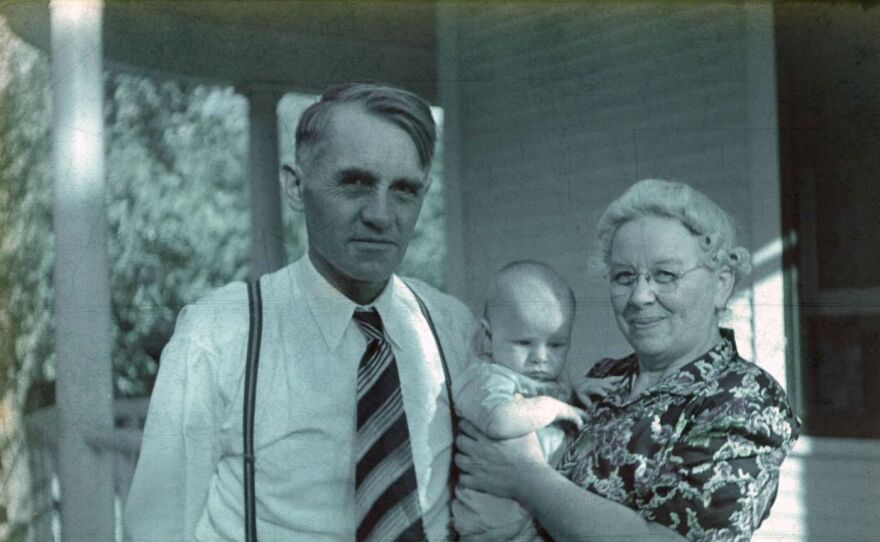
But it wasn’t just any home. Before placing a bid, they discovered it was the house Tim’s great-great-grandfather, Swan Olaf Crook, constructed more than 100 years ago, when the Swedish immigrant moved into town from the farm.
“Either, [it's] some kind of divine intervention or certainly good luck,” Tim said. "And the house is in wonderful shape."
However, the historic house was more than 4 miles from the countryside where the Youngquists wanted to live. They had to find a way to bring the old house and the family farm together.


The historic move
Crook immigrated to the U.S. from Sweden in the 1860s. He worked as a farm hand before buying land a few years later.
“And then in the early 1870s he borrowed a horse from the ranch, and as he was mounting onto the horse, the ranch manager told him, 'When you're looking for a property, find a place where there are white flowers that are growing, and that'll be the best, most fertile farmland,'” Tim said.
That farmland has been in the family for more than 150 years, making it eligible for recognition as a Heritage Farm by the Iowa Department of Agriculture and Land Stewardship. There are 10 Heritage Farms in Sac County and more than 2,000 across the state.


“The farm is older than a lot of American companies,” Tim said. “ You know, it's very special that we've been able to keep this together for so many generations.”

The Youngquists wanted future generations to grow up there. So, they moved the old house to the family farm.
They hired a company to haul the 120,000 pound, 2,000 square foot structure. A crew maneuvered the dwelling through the tiny streets of Kiron and out into the countryside in neighboring Sac County. Mandy said it brought a mixture of nerves and excitement for the couple.
“It's pretty wild to see, just like this massive thing coming over the horizon, cresting the hill on a gravel road," she recalled. "There are farm fields all around. It's misty, and then all of a sudden, this house just rises over the hill through the mist. It's pretty, pretty crazy.”
As Tim and Mandy walked over the wood floor and up a staircase, they envisioned their three small children in the house. They consider themselves lucky because they work remotely and have a knack for restoring old homes with good bones.
“I cannot wait to have a Christmas tree, you know, kind of sitting right here, some nice French doors around the corner,” Tim said.
A family farm future
Even more stunned to see the big house on the farm was Tim’s dad, Denny Youngquist.
"I'm glad it's here and everybody goes home with all 10 fingers, which is number one,” Denny said with a big chuckle.
The older Youngquist said having his son move back secures a succession plan for Tim to someday take over the operation. Studies show that as many as 80% of farms lack that kind of succession plan, and the age of the average Iowa farmer is almost 58 years old.

Denny recalled the last time he stepped inside the old Crook house. It was in the 1960s for Sunday dinner — he was 16. His grandparents, on the other side of the family, actually bought the property.
“It’s a stately old house, isn’t it?” Denny said.
Back then, people didn’t move away like they do now. Denny figures that economics and urbanization come into play today.
“Whether it's the Des Moines area, Omaha, Kansas City, Chicago, Minneapolis — that's not good, but it's the way it is," Denny said. "And you can blame Amazon, you can blame the internet. You can blame whatever, Walmart, you want. But it's just happened.”
The younger Youngquist plans to write the next chapter of his family's story alongside a gravel road, fields and grain bins.
“A lot of people, you think, 'Oh, the only way to find a future is to move to a bigger city. If you want to accomplish your dreams, you can't do it here in rural Iowa,'” Tim said. “And I disagree with that. I think that you can do anything anywhere you want, especially now in 2025.”

Tim expects renovations to take at least a year before his whole family can make new memories in the house his great-great-grandfather built after crossing an ocean and settling in the wilderness of western Iowa.
“Yeah, it's overwhelming in some ways to just think about all that history and all the feet on that floor, and all the memories and all the things that happened in there — and that we get to add to the story, I think is incredibly special,” Tim said.
